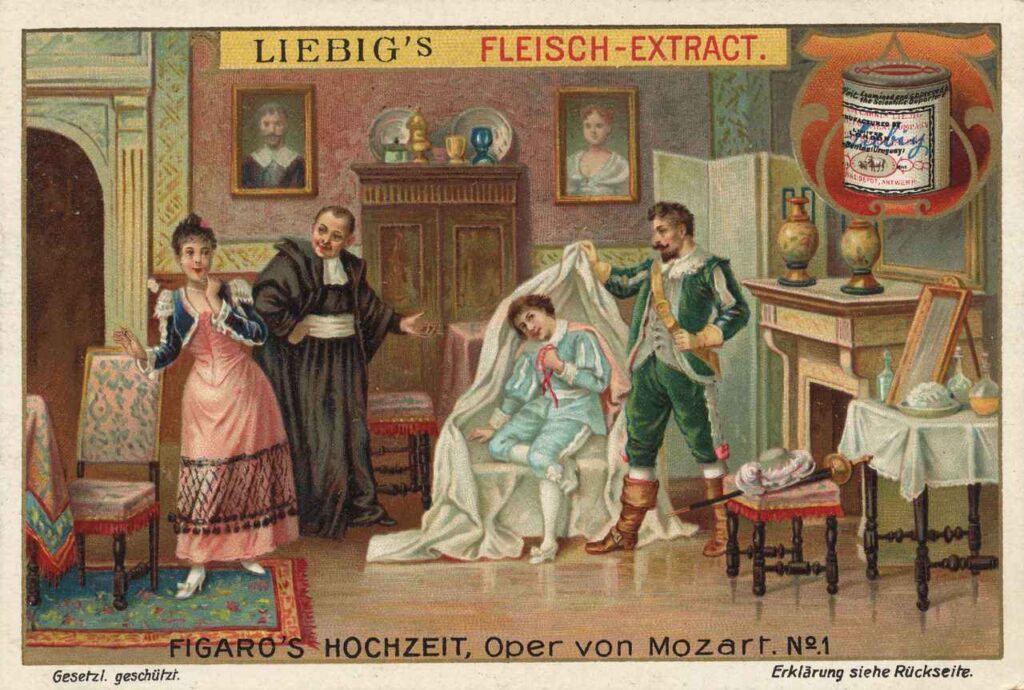
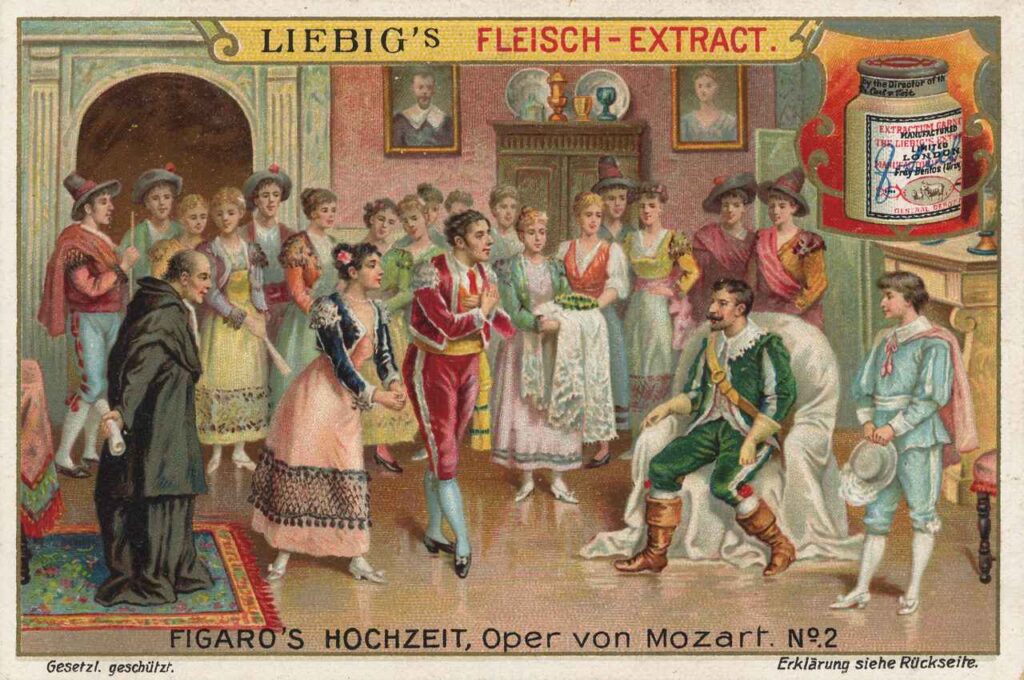
Anyone can write a plot synopsis, but how many can illustrate them with souvenir trading cards produced by a turn-of-the-century German canned meat company?? Yes, Liebig’s Fleisch-Extract (think of them as Spam and bouillon’s great-grandparents) produced collectible trading cards as part of their marketing campaigns. The plot synopsis below is illustrated with a set of six such trading cards produced in 1905 for Mozart’s The Marriage of Figaro. Delicious!
Plot Synopsis by Julian Rushton, “Nozze di Figaro, Le (‘The Marriage of Figaro’),” Oxford Music Online (2002) – edited and abridged by Adeline Mueller (c) 2026
Setting: Aguasfrescas near Seville, the Almavivas’ country house
Act 1 An antechamber
It is the wedding day of Figaro, valet to Count Almaviva, and Susanna, maid to Countess Almaviva. Figaro tells Susanna that the Count has offered them the room he is measuring, but she reacts with alarm: the convenience of answering them will also make it easy for the Count to visit Susanna when she is alone. Meanwhile, Figaro has promised to marry an older woman, Marcellina, if he cannot repay money he owes her. Doctor Bartolo is helping Marcellina, his housekeeper, in order to avenge himself on Figaro (who thwarted his plans to marry Rosina, the Countess, in Il barbiere di Siviglia). Cherubino, the Count’s young page, enters and confides in Susanna, impulsively babbling of his love for all women. The Count is heard; Susanna hides Cherubino behind a chair. The unctuous music master Don Basilio’s voice interrupts the Count’s amorous proposals; while he too hides behind the chair, Cherubino hops on to it and Susanna covers him with a dress. Angered by Basilio’s observations, the Count emerges and describes his discovery of Cherubino in young Barbarina’s room, hidden under a cloth … at which the youth is again revealed, to the Count’s indignation, Basilio’s cynical delight, and Susanna’s horror.
Figaro ushers in a rustic chorus praising the Count’s magnanimity in renouncing his extra-marital “droit du seigneur,” and the frustrated Count banishes Cherubino with an officer’s commission.
Act 2 The Countess’s chamber
The neglected Countess prays to the god of love to restore her husband’s affections. She and Susanna plot to dress Cherubino as a girl, take Susanna’s place, and compromise the Count. Cherubino sings a song he wrote to the Countess, and Susanna dresses him. The Count demands admittance: he has returned early from the hunt because of an anonymous letter (part of Figaro’s ill-laid plot). In confusion, the Countess thrusts Cherubino into her closet; Susanna enters unseen. The Countess tells the Count that it is Susanna in the closet. When the Count leaves to fetch tools to break down the door, taking the Countess with him, Susanna helps Cherubino escape out the window and enters the closet in his place. Upon the couple’s return, the Count is ready to kill, but it is Susanna who emerges, to the astonishment of the Count and Countess. Figaro then enters, again asking for an immediate wedding. Recovering his composure, the Count poses questions about the anonymous letter; Figaro prevaricates. Antonio the gardener charges in to complain of damage to his garden caused by the page’s leap from the window.
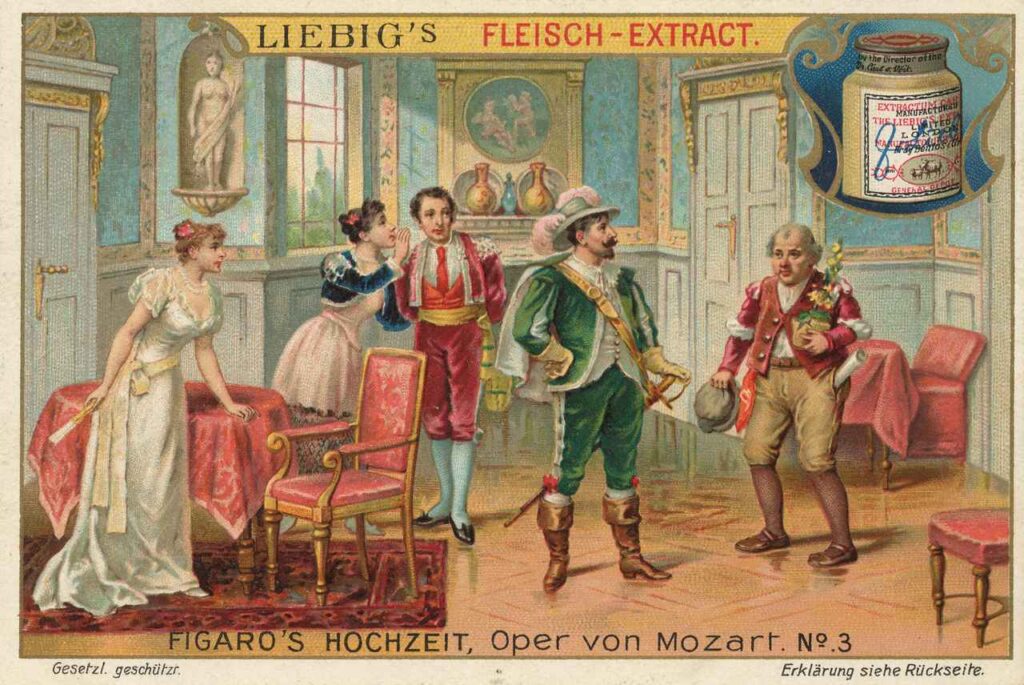
Figaro, with the women’s aid, claims it was he who jumped. The Count attempts (unsuccessfully) to expose the plot against him, when Marcellina, Basilio and Bartolo suddenly rush in demanding justice.
Act 3 A large room decorated for the marriage-feast
The Countess urges Susanna to make an assignation with the Count; they will exchange cloaks and compromise him with his own wife. Susanna approaches him and offers to meet him that evening. Leaving, she encounters Figaro and carelessly voices her satisfaction, which the Count overhears. He is again suspicious and angry. At the trial of Marcellina’s case, the magistrate Don Curzio is finding for the plaintiff. Figaro protests that he cannot marry Marcellina without his parents’ consent. It emerges that he is the lost son of Marcellina, and Bartolo admits paternity. The three express delight at their reunion; Susanna enters, misinterprets the embrace, and boxes Figaro’s ears. The comical explanation leads to a quartet of satisfaction against which Curzio and the Count fling out a defiant phrase of anger.
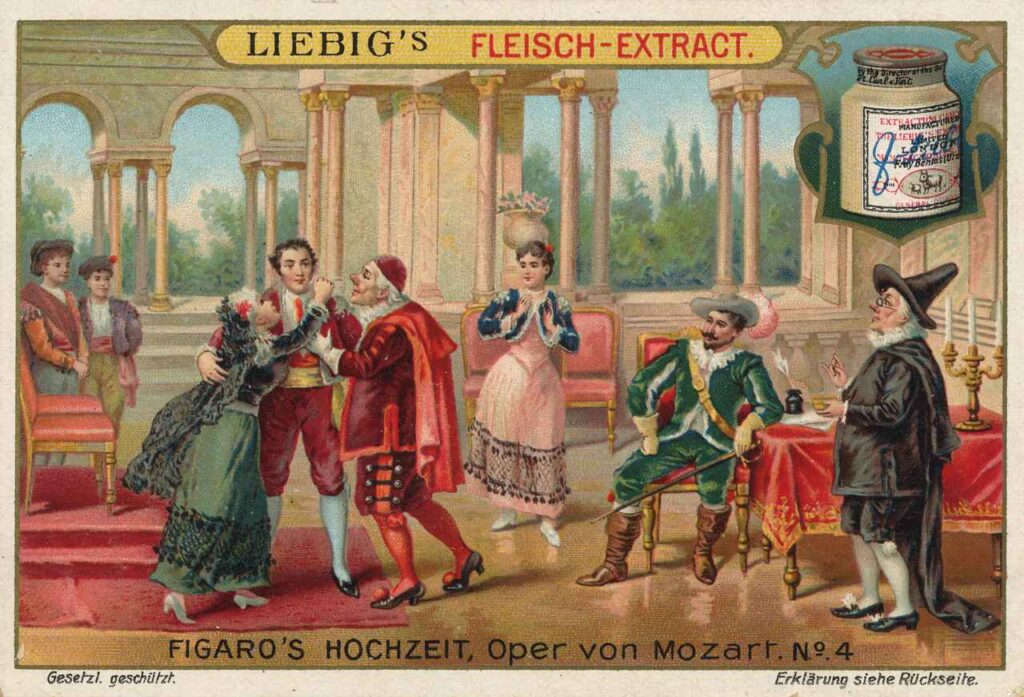
Later, the Countess dictates a letter from Susanna to the Count confirming their rendezvous. During a choral presentation to the Countess, Cherubino is unmasked, but allowed to stay for the wedding as he (and Barbarina) threaten to make revelations embarrassing to the Count. During the finale, two couples (Figaro and Susanna, and Marcellina and Bartolo) are presented to the Count and Countess.
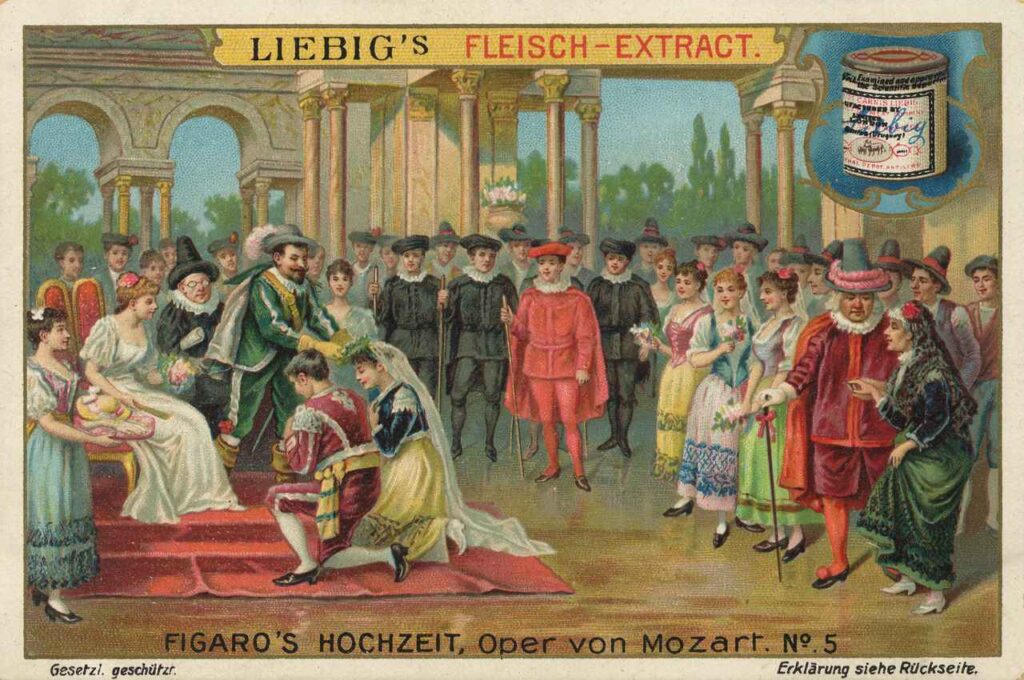
A fandango follows the wedding ceremony, during which Susanna slips the letter to the Count, sealed with a pin (to be returned as a sign of agreement); Figaro notices with amusement that the Count has pricked himself.
Act 4 The garden, at night; pavilions on either side
Barbarina, the go-between, has lost the pin; when she tells Figaro, he assumes that Susanna is unfaithful. He summons Basilio and Bartolo to witness the betrayal. Figaro overhears but cannot see Susanna, who is disguised as the Countess. From now on all is confusion; the characters mistake identities and blunder into each other in the dark, receiving kisses and blows intended for others, before nearly all of them end up in the pavilions. After recognizing her by her voice, Figaro reconciles with Susanna and they impersonate him pleading passionate love to the Countess. The Count bursts in on them, calling witnesses, dragging everyone including the false Countess from the pavilion, shouting accusations. The entry of the real Countess (in Susanna’s clothes) leaves the company breathless. The humbled Count’s prayer for forgiveness, and her loving response, build into a radiant hymn before the brilliant conclusion brings down the curtain on the crazy day.
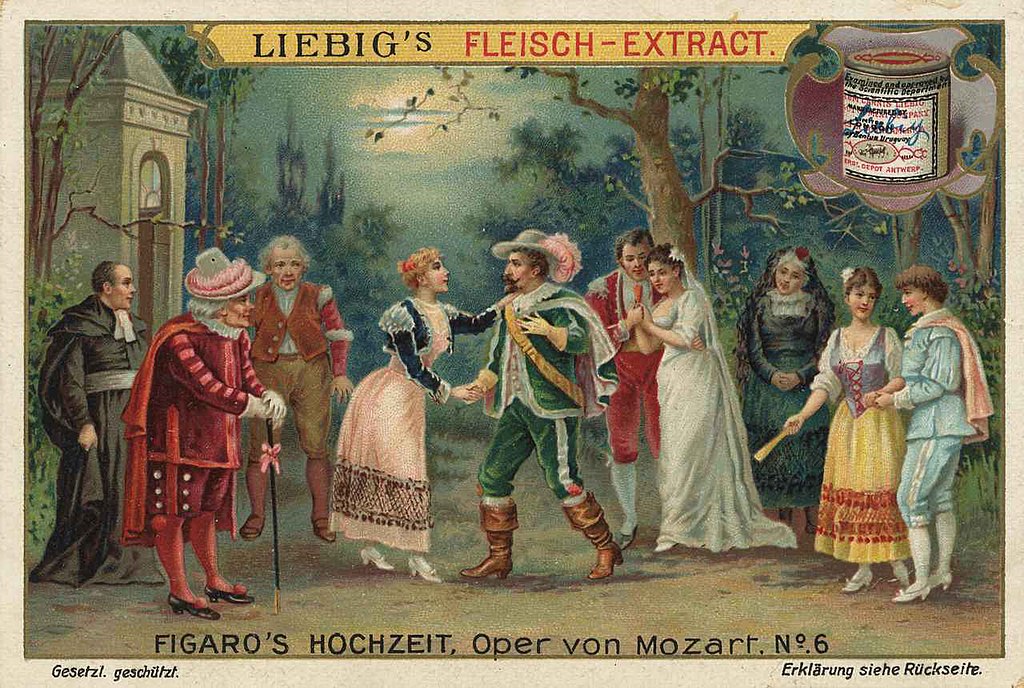
If these trading cards have a Pokemon-like appeal and you “gotta catch ’em all,” you can find 300 or so more at the Liebig trading cards page on Wikimedia Commons.