This is the Breuer house I chose to work on for the rest of the semester.
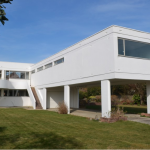
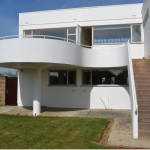
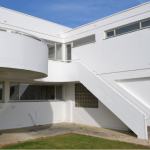
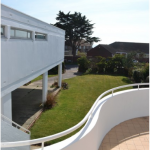
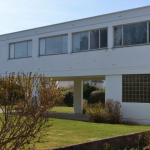
The Sea Lane House is the only building in britain designed by renowned FRS Yorke and Marcel Breuer. It was constructed in 1937 with a T-shaped floor plan. The long wing forming the stem of the T contains six bedrooms that take full advantage of the ocean view. Due to its 50 meter proximity to the ocean, orientation was a key factor in its design. It’s most innovative feature is that the entire bedroom wing stands on concrete columns that ensures a ocean view from all bedrooms. The graceful curving sun terrace also provides a ocean view and breaks up the rigid rectilinear modern style of the main base of the house. This marks the shift from Breuer’s modern approach to a more expressive style.
There are two spheres to this house. The ground floor provides a service area. It contains a maid’s room, utility room, two garages, a kitchen, and storage spaces. While all the bedrooms and living spaces are located upstairs. Because it is a vacation home there is a distinct separation of the working corridors from the relaxing and living areas. It was designed so that the service world had little interactions with the inhabitants upstairs.
The first floor includes a open fireplace and a dining room with full access to the sun terrace and garden. The two bathrooms, that lay adjacent to each other, are centered between the six bedrooms. All the rooms are perfectly rectangular feeding to its modern and simplistic form of the entirety of the house.
The entrance way does not lead to the ground floor (where the house workers reside) but rather to the first floor. The entrance is marked by a staircase that is conveniently located next to the garage providing little walking distance for the owners.
This house is highly organized in plan, with two distinct wings, one a sleeping area and the other a living and dining area. This was often seen in Breuers designs. The dining and living area are equal in size and shape adding to the precision of layout. Bedrooms 2, 3, 4, and the dressing area all share similar closet spaces and layouts. Rectangular forms are a repetitive pattern and are seen in every aspect of the house except for the columns and sun terrace.
The two story house is built with 11 inch brick walls. The bedroom wing is supported by reinforced concrete columns and floors. A continuous reinforced concrete beam runs around and encases the window openings. The entire house, including the stairs, is painted with a thick layer of white adding to the purist and minimalist modern look.
The house sits on a corner plot of land comfortably surround by a garden and large lawn adding to the relaxing and vacation atmosphere. The gardens generate a barrier to the outside world creating an illusion of seclusion. Where the lawn meets the house there are rectangular pathways of concrete that create a clean line that is repeated in the structure of the house.
Both the inside and outside of the house reflect the modern simplistic design of crisp straight lines. When proceeding from the outside to the inside the organization of the layout is expected, rectangular shaped rooms with similar sizes. On the elevation facing the ocean The windows are large but symmetrical following a predictable pattern. However on the opposite elevation there are clearstory windows located at the top. This was done on purpose because when ascending the stairs to enter the first floor, large windows on that wall would provide a intimate view of the inside to all the bedrooms. However, this is the only elevation that has clearstory windows as the other sides have vast windows to take in the view.
The house sits atop of concrete which is surrounded by grassy lawn. The bedroom wing that is supported by columns creates a roof entry way to the main garage. The roof has no apex and strictly consists of a continuous horizontal line. The windows on the ground floor, which are unable to see the ocean view, have no visibility but allow light to filter in.
Overall the sea lane house is an excellent example of a 20th century modern Architecture. The space serves its purpose as a family vacation home that reaps the benefits of its ocean view. But no one says it better than Breur who stated in an article published in the 1930’s that its “a seaside house for contemporary living… that owes… nothing to period mannerisms”.