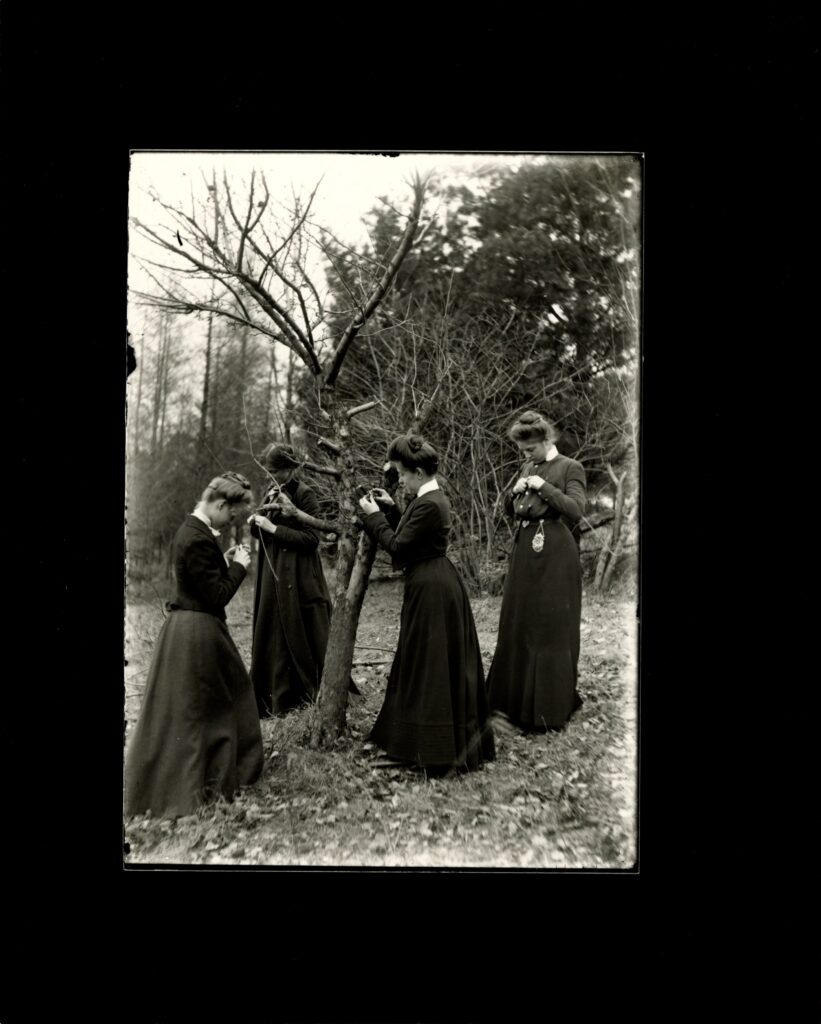
Herbaria making was once a common practice at Mount Holyoke College. Mary Lyon, founder of Mount Holyoke Female Seminary, herself kept an herbarium, which became the center around which the Seminary, later College, built its collection. With the plants students collected for botany classes, which were a required part of the curriculum from 1837 to 1898, they gathered and pressed plants for their own personal herbaria books and for the College collection. The herbarium was a regular part of coursework until about 1905. Collecting plant specimens was an approved activity during the daily walks required of all students in the early days of Mount Holyoke Female Seminary. Botany professors Lydia Shattuck (and class of 1851) and Henrietta Hooker (and class of 1873) made substantial additions to the herbarium. Emily Dickinson (x-class of 1849) kept an herbarium, which is now at Harvard’s Houghton Library and can be viewed online.
In 1917 the original herbarium collection was lost when Williston Hall, the art and science building, burned down. Professor Alma Stokey, who taught in the botany department from 1908 to 1942, developed a new herbarium with three focuses: New England flora, plants of economic importance, and a collection of ferns and fern allies, which were Professor Stokey’s specialty. She reached out to students, alumnae, professors, and other colleges for plant specimens to form the new collection. Professor Stokey also made quite a few contributions of her own, travelling all over the world to collect fern specimens and making exchanges with other institutions. The new herbarium continued to grow, despite getting less and less attention from classes. Oberlin College, Professor Stokey’s alma mater, donated over 700 specimens in 1934-1935, and, in 1938-1939, 1200 new specimens were added, with many of the plants being remounted and relabeled. One thousand more plants were added by Professor Ethel Eltinge in 1963-1964. Despite the biology department’s long dedication to its herbarium, the collection was essentially forgotten in the 1970s, when it became more focused on new equipment and its shortage of space.
The Mount Holyoke College herbarium serves as a part of our college history and a window into plant life of the past. Herbaria can offer insight into the lives of particular plant populations over time and can contain plants that are now extinct in a particular area. They provide an opportunity to examine plants from near and far in person, bringing distant nature to one’s fingertips.