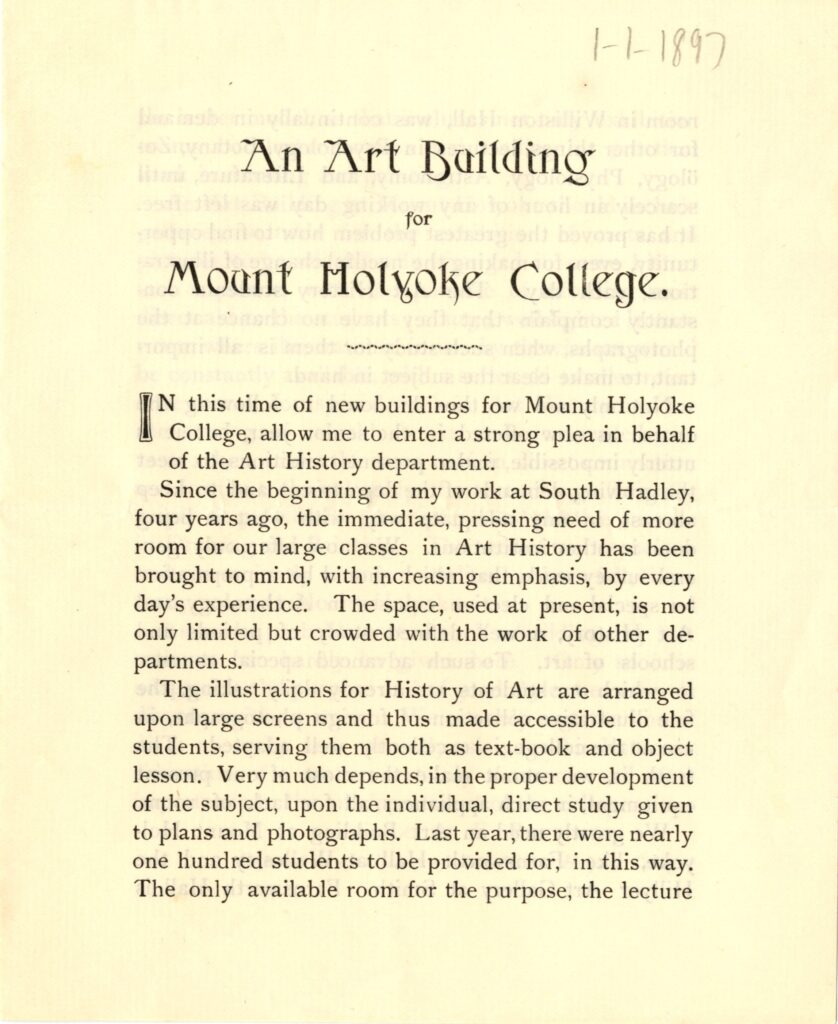
After the Seminary fire in 1896, Mount Holyoke entered a “time of new buildings”. Louise Fitz-Randolph proposed the idea of a new building for the art history department to her colleague, Anna Cheney Edwards, class of 1859, associate principal 1872-1888, and professor of Theism and Christian Evidences and instructor of Ancient Literature 1868-1892, who replied “Yes, we need an art building at Mount Holyoke, and you must ask for it.” On January 1, 1897, “An Art Building for Mount Holyoke College” was published. Fitz-Randolph provided reasons as to why a new art building was needed, what should be included in the new building, and which institutions to take inspiration from.
Despite multiple previous pleas and continued support from alumnae, little progress was made toward the building and a three year lull in progress commenced.
“Her devotion to the best interest of Mount Holyoke is fortunately memorialized in the building which took shape from the work she established.”
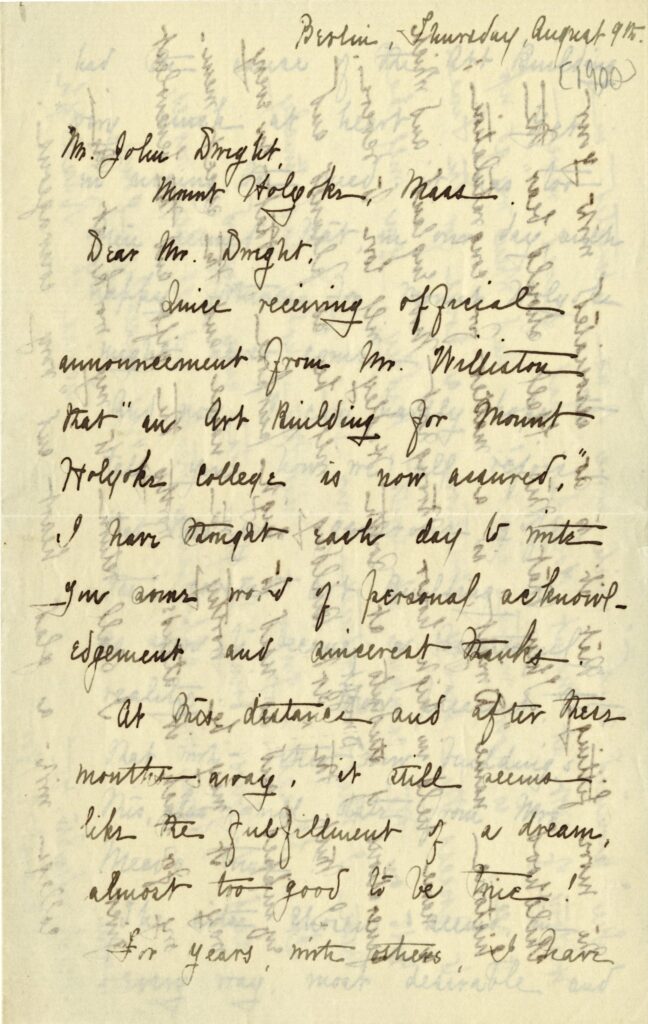
After the publication of “An Art Building for Mount Holyoke College,” Henrietta Hooker, a member of the class of 1873 and professor of botany, visited John Dwight in May of 1900 regarding the funds for this new building. It was only a few months later when Fitz-Randolph learned of the news that her plea was answered thanks to the generous donation by Dwight of $60,000.
She immediately wrote to both Dwight and A. Lyman Williston, a member of the Board of Trustees. She congratulated Dwight on the new building and expressed her gratitude for the support of both men, displaying her excitement to start the project that she worked so hard to make a reality.
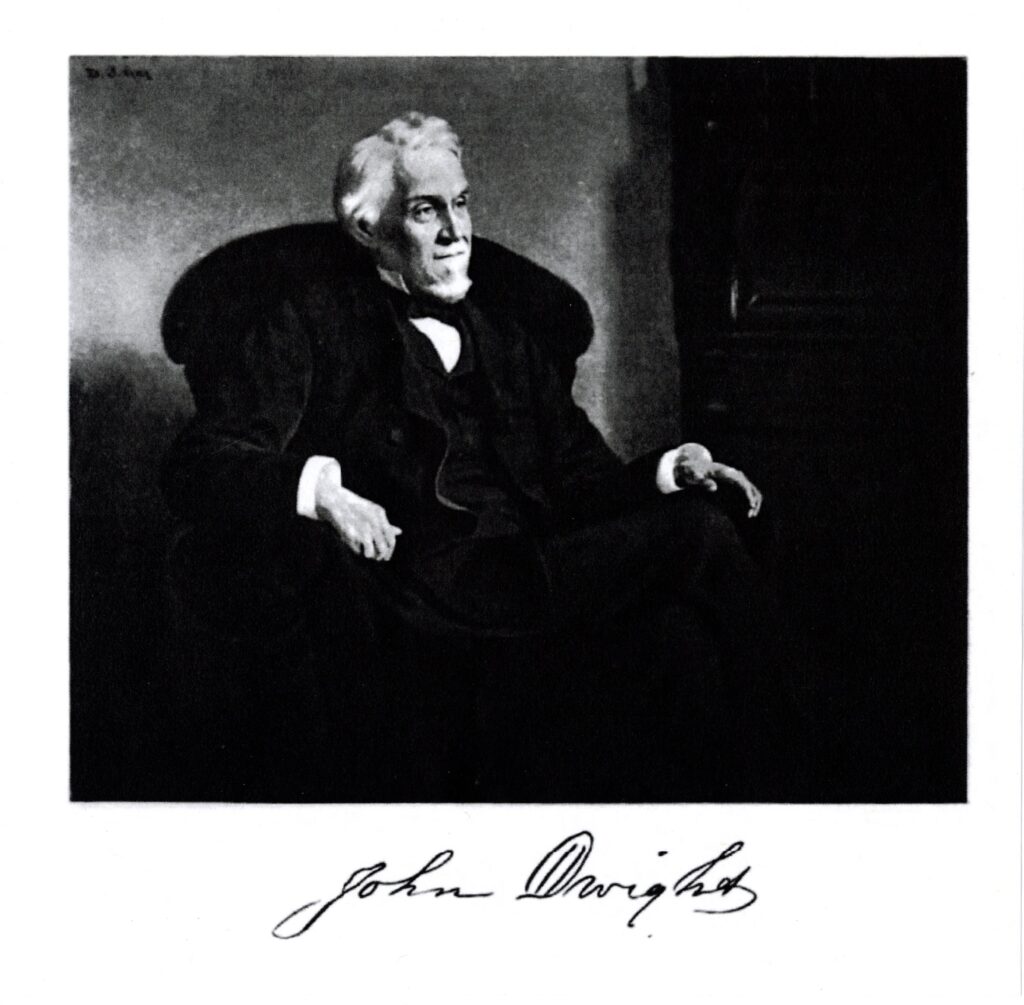
John Dwight was born in 1819 in South Hadley, Massachusetts on the Dwight family homestead, which would later be the site of the Dwight Memorial Art Building. Dwight was a manufacturer, businessman, and philanthropist and he was involved with Mount Holyoke Female Seminary from the beginning. In 1837, while delivering milk in pails suspended from an old fashioned neck yoke, every morning and evening to the milk room of the Seminary, Dwight met his future wife, Nancy Shaw Everett Dwight, x-class of 1839, who worked in the milk room. Dwight dedicated the Dwight Memorial Art Building to Nancy Dwight and his second wife Clara Leigh Freeborn Dwight. Fitz-Randolph, Dwight, and his father, Elihu Dwight, would spend many hours conversing over the decisions regarding both the interior and exterior of the building. John Dwight died in his New York City home on November 26, 1903.
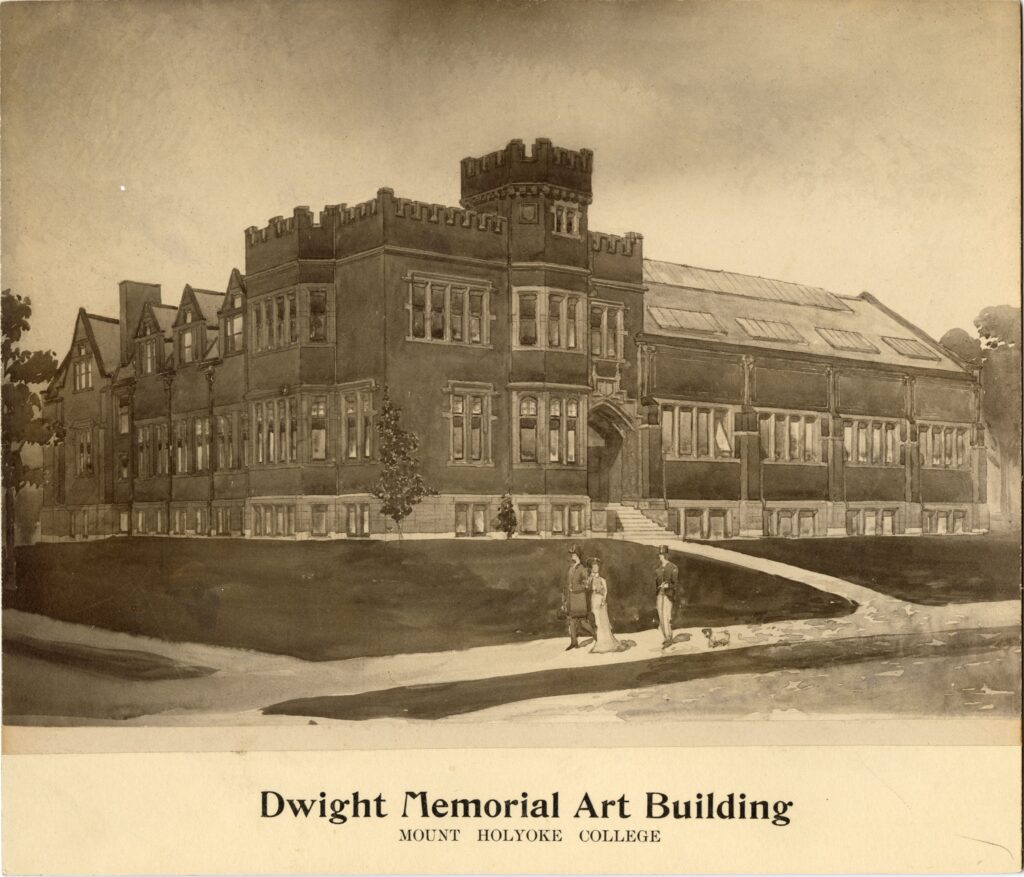
In December of 1900, ground was broken for the new art building. The selected architect George F. Newton also designed Mount Holyoke’s Williston Memorial Library. The layout of the Dwight Memorial Art Building received praise in The Mount Holyoke for being distinct from art buildings at Smith College or Amherst College, which is exactly what Fitz-Randolph wanted.
On the top floor was a lecture room, a large gallery space with frosted glass skylights (later named the Louise Rodgers Jewett Gallery of Paintings), studio rooms, offices, and space for exhibitions and various collections. The Elbridge Kingsley room, where nearly 400 of Kingsley’s engravings were housed, was also on the top floor. These were originally part of the personal collection of Clara Leigh Freeborn Dwight and later bequeathed by John Dwight, her husband, to the College.
The first floor contained a spacious vaulted central hall and a sculpture gallery, later named the Louise Fitz-Randolph Gallery of Casts. Also on the first floor was a library, three small galleries for early Greek art, and a lecture hall large enough to fit 160 people with two adjoining rooms used for storing photographs, engravings, and other illustrative materials.
In the basement was the Louise Fitz-Randolph Gallery of Egyptian Casts as well as general exhibitions and recitation rooms.
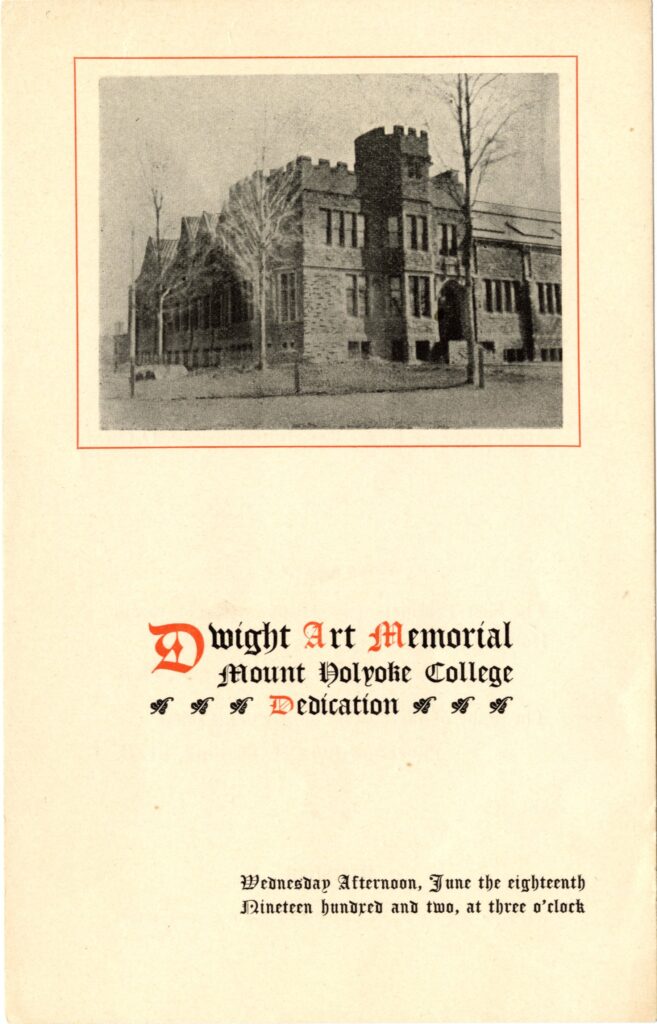
On June 18, 1902, the opening dedication ceremony of the Dwight Memorial Art Building was held. In an address given by Reverend Melatiah Everett Dwight, John and Nancy Dwight’s son, he states that “the knowledge of the beautiful [is] an essential part of a complete education.”