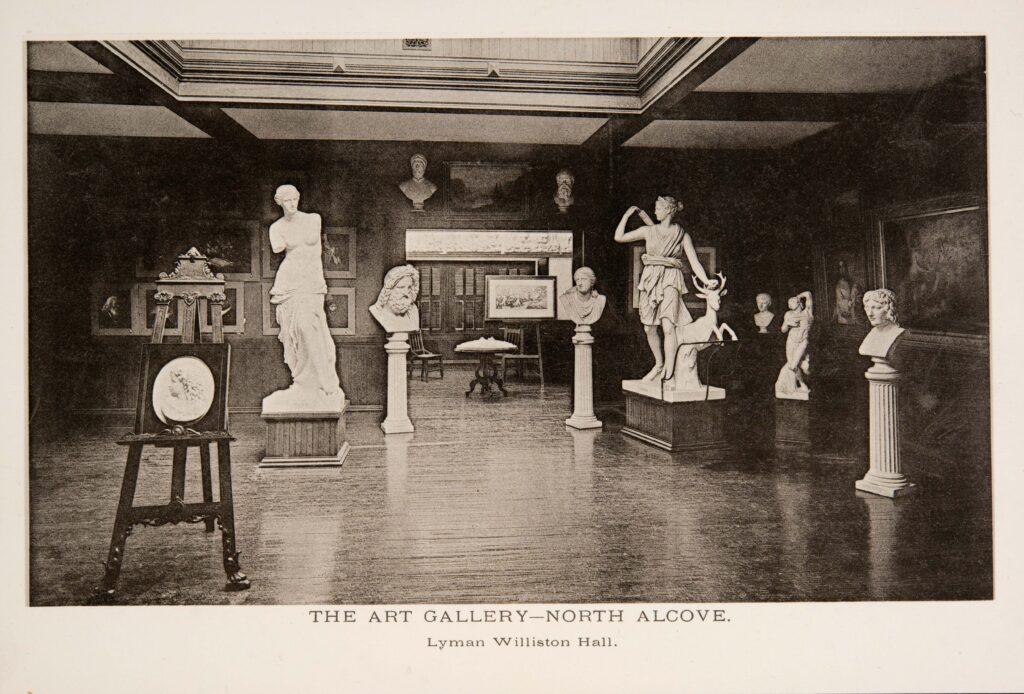
In the second half of the 19th century, approaches to art were changing in the United States and this was reflected at Mount Holyoke. Its art collection grew from a cabinet of missionaries’ objects to a full art gallery after the 1876 construction of Williston Hall. Williston Hall, a joint natural sciences and art building, was the first home to Mount Holyoke’s art museum.
The types of objects collected for the art museum show what kinds of art were valued at the time. Unlike the collections of Mount Holyoke missionaries, one would not expect to see anything originating outside of Europe and the United States in the new gallery. Classical Greco-Roman antiquities and Renaissance works were held in high esteem, and contemporary American landscapes were especially popular in the period after the Civil War.
Art was soon seen as not just something to be viewed and enjoyed, but something to be studied as well. Mount Holyoke became the second college after Harvard University, and the first women’s college, in the country to have an art history department. What was an art history course like in the late 19th century? Imagine studying artworks from small, black-and-white images clustered on classroom walls.
– Lena Holt ’27, Student Archives Assistant, summer 2026